Relationships & Trust
Our relationship with a dog is shaped by thousands of everyday interactions.
Trust is not created by expecting unquestioning obedience.
It develops when dogs experience us as predictable, supportive and safe.
The way we respond when a dog is worried, confused, excited or struggling can influence the relationship just as much as the training exercises we practise.
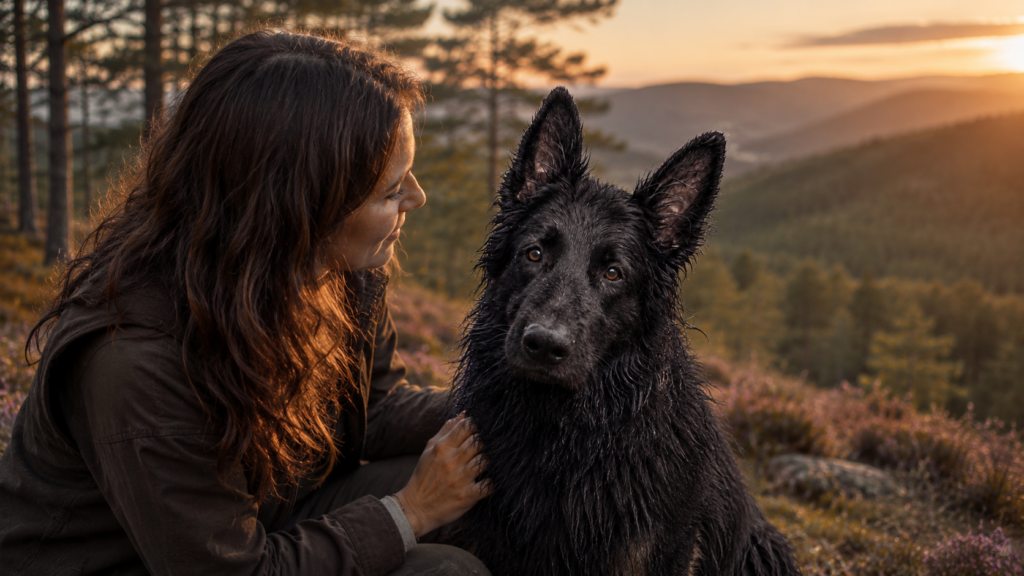
Trust Is Built in Everyday Moments
Relationship building happens when we:
- Listen to communication
- Respect requests for space
- Provide appropriate choice
- Respond consistently
- Avoid unnecessary conflict
- Help dogs feel safe
- Meet physical and emotional needs
- Adjust expectations
- Support rather than punish fear
- Make learning achievable
These small moments accumulate.
Understanding Before Judgement
Labels can quickly affect relationships.
If we describe a dog as:
stubborn
naughty
dominant
difficult
attention-seeking
we may begin responding to the label rather than the dog.
Curiosity gives us another option.
We can ask:
What is making this difficult for my dog?
What does my dog need from me here?
Have I made my expectations clear and achievable?
Does my dog feel safe enough to learn?
Choice and Agency
Dogs cannot control everything about their lives.
Humans decide where they live, when they eat, where they walk, who enters the home and many of the experiences they encounter.
Where it is safe and practical, offering appropriate choice can support confidence and trust.
Choice might involve:
- Whether to approach
- Whether to interact
- Where to rest
- Which direction to explore
- Whether to continue handling
- Taking breaks during training
- Creating distance from something uncomfortable
Choice does not mean dogs never have boundaries.
It means recognising that agency matters.
Repair Matters Too
No relationship is perfect.
There will be times when we misunderstand our dogs, respond too quickly or realise afterwards that we could have handled something differently.
Trust is not dependent on perfection.
We can learn.
We can change our response.
We can create different experiences next time.
That willingness to keep learning is part of the relationship too.
Explore Relationships & Trust Resources
This area of the Movement Library will continue to grow with practical resources designed to help you explore trust, connection and the human-dog relationship with greater understanding.
You’ll find resources exploring topics such as:
- Building trust through everyday interactions
- Choice, agency and emotional safety
- Supporting confidence
- Helping rescue and newly adopted dogs settle
- Human expectations and assumptions
- The language we use around dogs
- Reflecting on our own responses
- The WHOLE™ Framework
- The CARE™ Framework — Compassion, Assessment, Relationship and Education
- Understanding the human side of the relationship
As new guides, workbooks, worksheets and learning resources are added, they will be linked here.
The Human Side of the Relationship
Seeing Dogs Differently is not only about understanding dogs.
It also asks us to reflect on ourselves.
Our expectations.
Our language.
Our emotions.
Our assumptions.
Our responses.
The Human Understanding Framework explores this side of the relationship in more depth.
Relationship Before Performance
Training matters.
Skills matter.
Boundaries and safety matter.
But the relationship in which learning takes place matters too.
When dogs feel understood, supported and safe enough to communicate, we create better foundations for learning and life together.
Trust is not something we demand.
It is something we build.